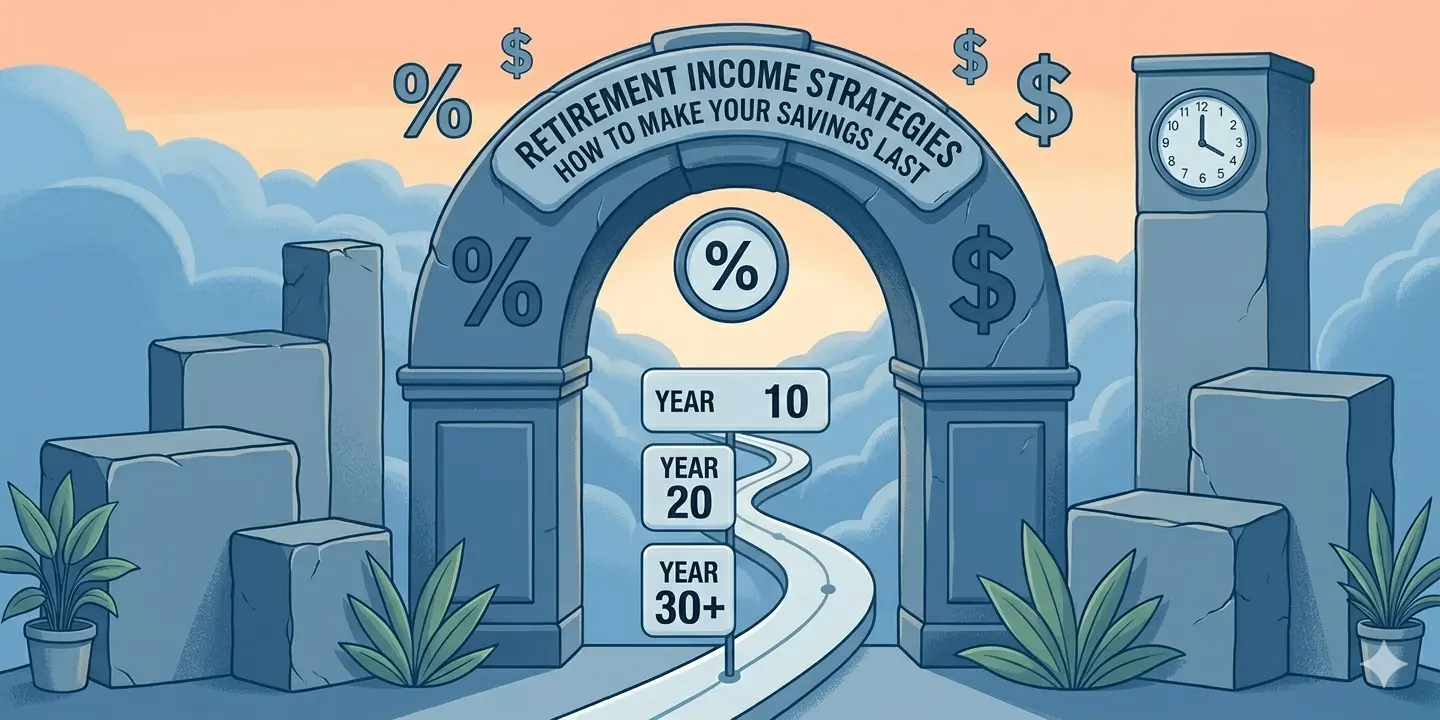

What Is the Bucket Strategy?
The bucket strategy is a way of organizing your retirement savings into separate groups based on when you will need the money, so that a falling market does not force you to draw from long-term savings at the wrong time just to cover this month's bills.
The core idea is that different portions of your retirement savings serve different purposes and operate on different timelines. Money you need in the near term stays in stable, accessible form. Money you will not need for several years has more time to work, and money you will not need for a decade or more has the longest runway of all.
By keeping near-term spending needs in a stable, accessible portion of your savings, you create a buffer that allows the longer-term portions to recover from a difficult market period without being forced to draw them down at the worst possible moment. You stop being, as retirement planning professionals sometimes put it, a forced seller in a down market.
This is an educational framework for thinking about retirement income distribution planning. How each bucket is actually structured, and what sits inside it, involves investment decisions that Apex coordinates with independent investment advisors who are licensed to address those specifics.
Why Retirees Find This Framework Useful
The bucket strategy addresses a specific and well-documented challenge retirees face. A significant market downturn in the first few years of retirement is far more damaging than the same downturn later in retirement, because early losses come from a balance you are already drawing from and leave you with less to participate in the eventual recovery. This is the concept of sequence of returns risk, and it is one of the most important dynamics to plan around in retirement income distribution planning.
Beyond the math, there is a real behavioral benefit to this approach. Retirees who can see their near-term spending needs already set aside in stable form tend to make better long-term decisions with the rest of their savings. When a market drops, it does not change what they are covering for the next year or two. That separation can reduce the impulse to make reactive decisions during difficult periods, which is often when the most lasting financial damage is done.
How the Three Buckets Work Together
A typical bucket framework involves three layers organized by time horizon.
The first bucket covers near-term spending needs, generally the next one to two years. The goal here is stability and accessibility, not growth. This is the source of your monthly retirement paycheck and it is designed to be completely insulated from short-term market conditions.
The second bucket covers a medium-term window, generally somewhere in the range of three to seven years of spending needs. This portion has more time to work than the first bucket and can be positioned with a different set of priorities. As the first bucket is drawn down over time, the second bucket is designed to refill it.
The third bucket covers longer-term needs, generally years eight and beyond. With the longest time horizon of the three, this portion has the most runway to participate in long-term growth and is designed to eventually replenish the second bucket over time.
How these buckets interact and when the longer-term bucket is used to replenish the others is one of the more nuanced parts of the strategy. Many approaches involve being thoughtful about the timing of those transfers, such as drawing from the longer-term bucket during periods of market strength rather than when markets are under pressure. The investment decisions within each bucket are ones that qualified investment advisors address, not something Apex handles directly.
How Large Should Each Bucket Be?
There is no single right answer, and the appropriate sizing depends on your household's actual spending, your other income sources including Social Security and any pension income, your overall asset level, and your timeline. The right structure for one family can look very different from what makes sense for another.
As a purely illustrative example, a household that needs $80,000 per year in total and receives $40,000 per year from Social Security has a net annual spending gap of $40,000. The near-term bucket for that household might hold one to two years of that gap, the medium-term bucket might hold several more years, and the remainder would sit in the longer-term growth-oriented portion. These are general educational illustrations, not recommendations. A complete assessment with an independent investment advisor is the right way to determine what sizing actually fits your situation.
A Common Question: Doesn't Holding Cash Drag on Returns?
It can, in a narrow sense. The near-term bucket is not designed to maximize growth. But the purpose of keeping near-term spending in a stable, accessible form is not to optimize a return calculation. It is to make sure you never have to draw from your longer-term savings during a market downturn just to cover living expenses.
The potential cost of being forced to sell long-term investments at depressed values early in retirement, the sequence of returns problem, can significantly outweigh the cost of keeping a portion of savings in a more conservative, stable position. This is widely understood among retirement income planning specialists as one of the core arguments for maintaining some form of spending buffer.
There is also what might be called an emotional return on having near-term needs covered. A retiree who is not anxious about what a market downturn means for next month's bills tends to make better long-term decisions with the rest of their savings.
Where This Framework Fits and Where It May Be a Weaker Match
The bucket framework tends to work well for retirees who have enough total savings to meaningfully cover several different time horizons, who want a clear and intuitive way to think about their income structure, whose spending will vary across different phases of retirement such as more active travel years followed by quieter years, and who find that having a visible structure helps them stay disciplined during market uncertainty.
It may be a less natural fit for households where total assets are very limited and every dollar needs to be working as efficiently as possible, where the great majority of income is already coming from reliable non-market sources like a pension and Social Security and the investment portfolio is primarily for legacy purposes, or where a simpler systematic withdrawal approach feels more manageable and the household is comfortable with that level of market exposure.
The bucket strategy is a framework, not a formula. Whether it fits your situation, and how it would be applied, is a conversation worth having with both a retirement income planning specialist and a qualified investment advisor.
Ryan's Perspective
"The bucket concept is a tool, not a rule. I find it genuinely useful for most of the families I work with because it solves a real problem: it helps people avoid making the worst possible decision at the worst possible time. But how it gets applied, how much sits in each portion, and how the pieces fit together with Social Security, insurance-based income, and the overall household plan, that looks different for every family. The framework is the starting point. The plan is built around your specific situation." — Ryan Skinner, Founder, Apex Retirement Services
How Apex Retirement Services Approaches This
At Apex, we do not start with the bucket structure. We start with the spending plan. Once we understand what a household actually needs each month, and where reliable income sources like Social Security and insurance-based income solutions already cover part of that need, we work through what the overall income structure should look like and how a bucket-style framework might fit into it.
The investment components of that structure are addressed in coordination with independent investment advisors who are licensed to make those decisions. Ryan's focus is on the insurance-based income layer, including solutions that may help provide a reliable near-term income floor regardless of market conditions, which can work alongside or in place of the first bucket depending on the household's situation.
If you would like to explore how a retirement income structure might work for your household, we would be glad to start that conversation.